A Tale on The Mile
Throughout the course of human history, societies have always grown from the same fundamental principles, regardless of the time or place.
Society seems to be a symbiosis, a macro-organism. Individuals cluster together to work as groups, which form a mind of their own, and in turn influence each individual. These small tribes that begin around a campfire, on the beach or on the mountain, create towns. Those towns become cities, those cities unify to create countries. It may seem strange, but often the story and character of an entire nation of people can be read in a single one of its streets.
A Tale on the Mile is the work of photographer David Guillen, it is a harmony of original photography and text that will explore the personalities and places on one of the most historically vibrant streets in Scotland: The Royal Mile.
The Tale
As with every tale, we need a narrator to tell our story... Allow me to present myself: my name is David and if you trust me, as he did,
I promise you’ll never forget this journey. This story, which unfolds in the space of one Mile, speaks of struggle, of transformation, of finding yourself, of returning to your roots and allowing them to become part of you. So many people form part of this tale that it’s nearly impossible to name them all. But they already know the story. So now I invite you to be part of it, too.
PROTECTION
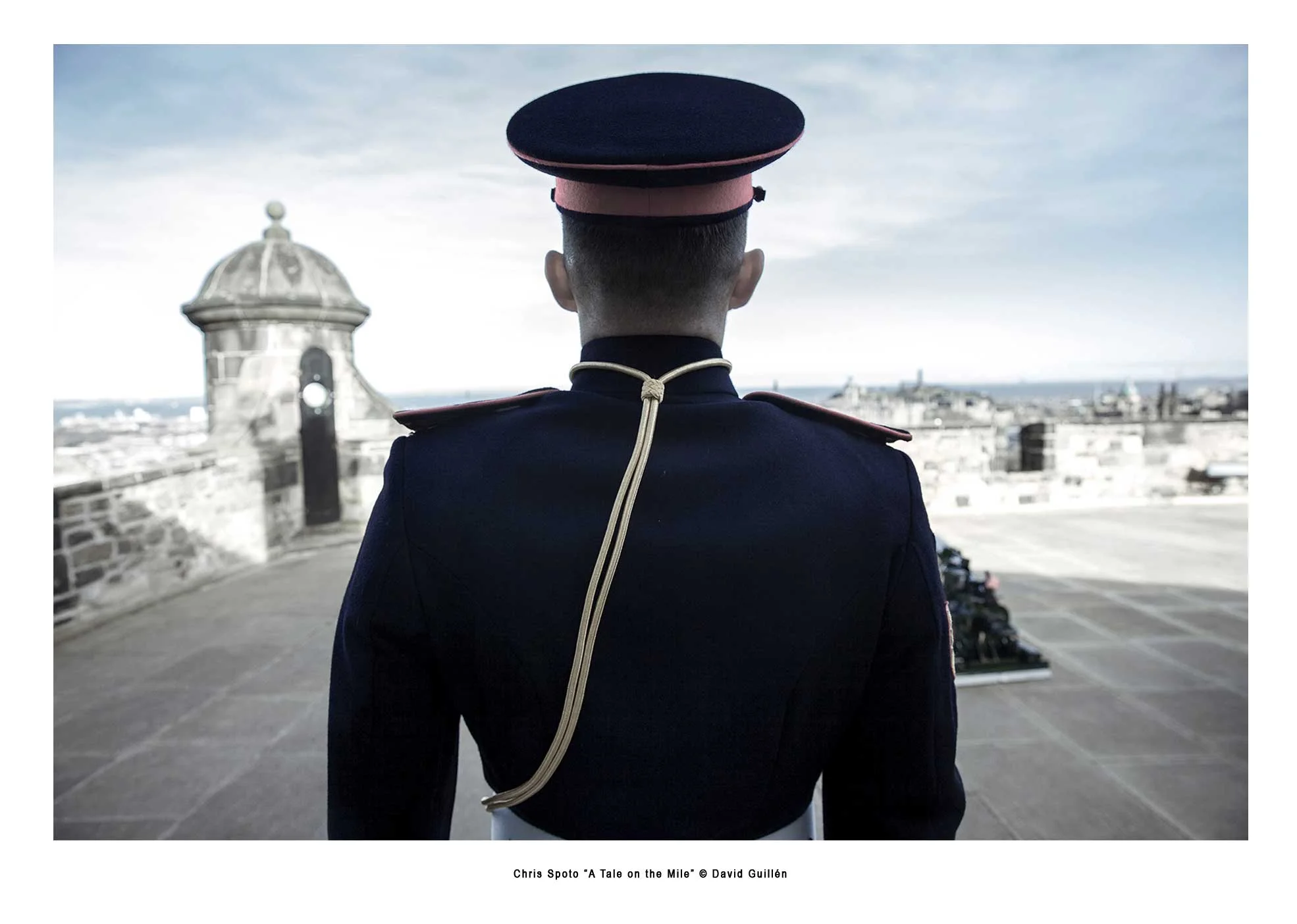
The first day begins with silence. He wasn’t alone, but it felt that way. He silently craved attention, a hug or a supportive look from the people around him. He craved for these afternoon hours to quickly morph into the evening hours. He felt far away from home and felt the coldness that reigned over everything envelop him and his senses. The first thing we always do in times of hardship is to find a refuge, a safe place; not a hiding place, but a fortress. These strong stone walls embracing the Mile became his shelter and the idle volcano his resting place.
SYSTEM
The morning after, the castle doors were open to the world so he decided to take a walk out in the open air. He looked down at the lines drawn on the street, the shape of the buildings and even the style in which people were walking. He looked up and down as if possessed, fixated in every detail, in every brick, trying to pick apart the secrets of the system that surrounded him. As he walked down, the courts appeared on the right and the bank on the left where money is guarded be- hind walls; held captive like a prisoner. A few steps further, the council - bringing order to the street and people that live here. And now, arriving at the end of the Mile, the parliament and palace come into view as a symbol of tradition and roots. This system, he thought, is like a mix of time and a succession of steps that we have to climb to reach the next one.
WORK
A few days passed by until he was nally welcomed as a small part of the many grinding gears making up the system. In the meantime, he dedicated time to walking up and down the Mile and observing the faces of the people who play a crucial role - men and women who worked their way through every phase of life to keep the machine well-oiled. Behind the walls, kitchens never stopped producing the fuel for this journey we’re all on board. Everyone’s in their place and in their role playing it out to a de ned rhythm, like a well-orchestrated band where hundreds of sounds combine to create one harmonious note. That very afternoon he sat down on a bench and wrote: ‘I have my hands and legs that are strong, I have my voice and my experience that are gold. I have hope and future before me. This is the wind that brought me to this land’.
FAITH
Walking back up to the castle he passed by the ceme- tery. It was the rst time he had gone in. Blankets of snow were hiding some of the stones and decaying owers lay still on top of them. He felt a chill and forced his steps to quicken. And with the cold now in his bones,
he sat down by a window in the castle and silently observed the street sloping down. All the people moved like busy ants below him and he knew that something more profound, something unexplainable, was embracing all the space and him. Questions raced through his mind:
Why? Where? How? When? What for?
There’s something more important than the fuel produced by the kitchens, more profound than all this machinery whose gears never stop grinding. Faith. It’s in the air we all breathe. Faith can be found in the words of people who speak out from their pulpits.
It’s in the writing of philosophers immortalised in statues on the Mile and in science that attempts to understand the theory and solution.
With all this, he realised that the mystery he was trying to decipher was he himself. ‘Your faith can move mountains’, as the saying goes, and between two mountains there was him. Like a ray of sunshine beaming down, he thought he heard a voice whispering to him, cutting through all the noise. He understood that the answer was much closer than he thought.
ROOTS
The winter had been blown away and the Mile was shining brighter than ever. That very morning he left the castle as if bewitched. He told me it was the very same wind blowing against his back and legs that brought him here. He stopped for a moment and the same chill from last winter brushed against his body. He looked up and saw the palace emerge before him, bringing the Mile to its natural end.
The wind was blowing even stronger than before, shouting at him, and with a spell cast over his body he began striding along the palace walls. Then something much older appeared: stone arches suspended in the air.
An overwhelming silence hung in the atmosphere. Suddenly, one last gust of wind whisked him up into the air and shook him to the core. It blew him even further down to where it all begins. A mighty mass of stone, sand and water, and he, who thinks he’s seen it all, doesn’t give credit to the spectacle in front of his eyes. He couldn’t resist the temptation to fall into its arms, to drink from its water and to take refuge amongst the stones forming improvised fortresses. Only then did he understand the true meaning of protection. As he watched the rainwater maintaining the river ow, he grasped the importance of maintaining the system. A nearby bird was collecting twigs from the ground to build its delicate nest with patience, effort and work. He closed his eyes.
He no longer had any more questions to ask. He no longer had any more answers to find.
Text by David Guillén
Exhibition at the Museum of Edinburgh